Jump To

PLAY. PATTERN. INSIGHT
Timeline
2026/01 —— Present
Project Type
Social Impact Design
Game Design
Contribution
UI/UX Designer
Game Designer
Prototyper
Researcher
Tools
Figma
Procreate
Illustrator
Unity
Overview
Sokids is a research-driven, child tablet game project developed by a student team at Carnegie Mellon University's Entertainment Technology Center in collaboration with the Center for Transformational Play.


Project Overview
Project Description
SoKids is an interactive digital and scalable tool designed to help researchers understand how children aged 3 - 6 perceive social categories; in this case, race is the project's focus.
The design integrates engaging gameplay with psychological research methodologies, and the project transforms traditional data collection into an immersive experience.
Client
Catarina Vales, Ph.D.
She is a Research Scientist in the Department of Psychology at Carnegie Mellon University and the Director of Research at the CMU Children’s School. She leads the Cognitive and Social Development Lab, where her work focuses on understanding how children acquire knowledge about the world and the people around them to help them grow and thrive.
The Challenge
The Design Paradox


The primary challenge of SoKids is maintaining Scientific Neutrality within an Immersive Play Environment.
Collect meaningful research data without teaching the child or reinforcing existing stereotypes/biases.
For the Children
For the Researcher

Balance Two Competing Goals

Create a fun, intuitive experience that encourages natural behavior.
Ensure the game does not teach or reinforce social biases, stereotypes, or categories before the data is even collected.
Addressing Bias & Stereotypes
Neutral Asset Design
We carefully curated the visual identity, from color palettes to character silhouettes, to ensure they didn't trigger existing social stereotypes


Mechanical Objectivity
Ensuring that game feedback were tied to the completion of the task rather than the nature of the social choice made by the child.
Data Collection vs. Playability
We are designing a bridge between raw data and digital play. The UI must be simple enough for a child to navigate independently, yet robust enough to capture the nuanced decision-making patterns that Dr. Vales needs for her study.
Research
Competitive Analysis

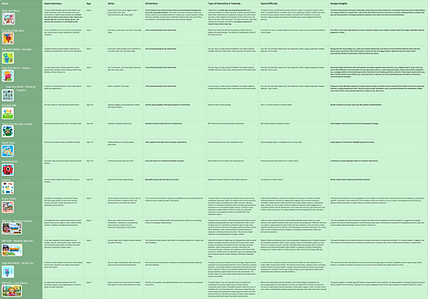
We analyzed existing children's tablet games, focusing on the user interface and interaction system.
Takeaways
Simple Game Verbs
Preschoolers are still developing their motor skills. Our game interactions need to be as accessible and simple for the kids to navigate and control.
A clean user interface will allow the children to stay focused on the task.
Clean & Simple Graphics

Literature Review
Color Palette
Children are drawn to colorful and vibrant elements. Therefore, our game's color palette is designed to appeal to kids.
Our team reviewed numerous research papers to understand the design for children, psychology methodologies, and the HCI aspects of this project.

TIDRC Framework: Bridging the Gap in Children’s Touchscreen Design
Make it Intuitive
Use symbols kids recognize from real life, keep text to a minimum, and always use voice instructions along with pictures.
Gesture Limitations
Prioritize simple, single-finger inputs like tapping to accommodate the developing motor skills of children aged 3–6.
Feedback
Provide immediate sensory reinforcement for all actions while avoiding extrinsic rewards that might skew the behavioral data.
Nikita Soni, Aishat Aloba, Kristen S. Morga,
Pamela J. Wisniewski, and Lisa Anthony. 2019.
Play and Implicit Bias in Early Childhood
Implicit Bias
Unconscious stereotypes in teachers can lead to discriminatory behavior and negatively affect student-teacher relationships and academic assessments.
Early Group Bias
Children as young as four years old can form in-group biases simply by observing how adults use social categories to organize environments.
Value of Pretend Play
Imaginative play is essential for healthy development, helping children build creativity, emotional regulation.
Case Western Reserve University. Schubert Center for Child Studies. (2014) Play. https://artscimedia.case.edu/wp-content/uploads/sites/35/2013/12/14193811/Play-and-Implicit-Bias-Brief.pdf.
Critical Race Theory for HCI
Embeded Racism in Tech
Racism is built into everyday tools and designs, even when the creators have good intentions.
Color Blind Designs
Ignoring race in designs often hide real unfairness instead of helping to fix it.
Designers Hold Power
The people who build technology choose what is important, which can either support or fight oppression.
Ihudiya Finda Ogbonnaya-Ogburu, Angela D.R. Smith, Alexandra To, and Kentaro Toyama. 2020. . https://doi.org/10.1145/3313831.3376392
Visual Identity
Logo Drafts


Final Design



The logo aims to reflect both our project stakeholders, balancing between institutional and playful feelings.



The letters are made of building blocks that represent the project's connection to preschoolers, and the modern typography design provides an academic feel that complements our project.
Color Palette


Jungle Green
0B825F
Slate Blue
5F5AC1
Racing Red
EE2C2C

Blush
Pop
0B825F

Burnt
Peach
E96E56

Bright
Amber
F3C915

Our project's color palette reflects a mix of primitive colors and vibrant, youthful shades.
Website

As the visual lead for the project website, I designed the layout to reflect our core brand identity. I also created the custom brand assets and graphic elements currently used throughout the site to ensure a consistent look and feel across all pages.

Home Page
I designed the layout and visual language of the home page to immediately establish the project’s identity. The design centers on the "Big insights into little minds" mission, using the brand assets I created to balance a playful aesthetic with our professional research goals.
Blog Page
For the blog, I created a series of custom, hand-drawn weekly headers to keep the project’s progress feeling personal and engaging. These assets bring a consistent visual rhythm to our weekly updates while maintaining the vibrant, non-biased color palette established in our branding.


Team Page
I directed the visual style of the team page to highlight our multidisciplinary backgrounds. By using circular crops and colorful background accents, I unified the team’s portraits with the overall project identity, ensuring the interface remains approachable and child-friendly.
First Prototype
Current Development

To see which design directions work best, our design team is currently running parallel prototypes to see which interactions work best for the kids.
I am leading the development of the first low-fidelity prototype and also providing cross-functional support to my teammates in implementing the second iterative version.
Paper Prototype

1
I started with drawing digital sketches for some game scenes and interfaces.


2
Then I transfer the ideas onto the paper prototype.


3

I am currently working with the development team to transition the paper prototype to Unity.
User Journey
1
Birthday Invitation Card
The user will receive a birthday invitation card from their best friend.
2
Create Avatar
Then they will customize their own avatar and dress up for the party.
3
Entering Friend's House
The user traces a line to enter a friend’s house, which is randomly assigned as either a small home or a large mansion.
4
Arrive at the Party
The user selects a best friend from a diverse group to give a present to.
5
Dropped Gift
Users will see an animation of a chracter left and dropped their gift.
6
Gift Detective
The user acts as a gift detective by matching a dropped gift to the correct adult family member.
7
Arrive at the Party
The user selects a best friend from a diverse group to give a present to.
8
Choose Teammates
The user chooses two teammates from a pool of characters to compete in a swim race.
9
Giving Prizes
The user ranks and distributes three different tiers of prizes to the characters in the scene.
10
Giving Prizes
The user freely decorates a scrapbook with stickers of various characters to create birthday memories.
Data Points
Game Scene | Action | Primary Research Insight |
|---|---|---|
1. Self-Identification | Trait selection order & accuracy | Measures self-awareness and trait saliency. |
2. Status Mapping | Character-to-house size correlation | Investigates associations between race and wealth. |
3. Social Preference | Selection latency & best friend choice | Tracks natural affinity and in-group vs. out-group bias. |
4. Swim Race | Teammate selection ratio & order | Analyzes group bias within a competitive context. |
5. Gift Detective | Matching accuracy & feature priority | Tests visual continuity and familial categorization. |
6. Prize Distribution | Forced choice ranking & exclusions | Measures how high-status rewards are allocated. |
7. Scrapbook | Spatial clustering & relative scaling | Identifies perceived social status and grouping habits. |
Our prototype translates complex social behaviors into measurable data points. By tracking player decisions in a game environment, we provide researchers with objective insights into how children perceive their social world.
